Climbers and Self-Supporting Plants Have Different Growth Habits
Climbers and self-supporting plants shape garden space differently. Learn to identify what carries each plant’s form and make clearer layout decisions.
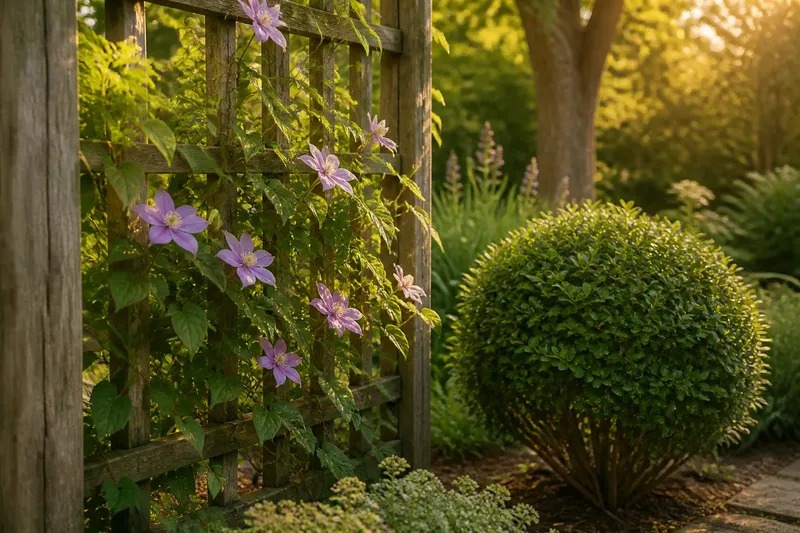
A vine runs through the openings in a fence, while a nearby shrub holds its own rounded outline. That contrast makes climbers and self-supporting plants easier to distinguish: one uses an outside structure to rise or spread, while the other carries its shape on its own stems. Knowing which structure is doing the work helps you decide where each plant belongs and what kind of space it needs.
Do not start with height or a plant label. Follow the stems, look for attachment, and notice whether the plant’s outline depends on a fence, trellis, or neighboring trunk.
Climbers use a support to extend through space
A climber sends stems outward or upward, but it generally needs something else to keep those stems elevated. That support might be a trellis, wire, fence, pergola, tree trunk, or another plant. The climber supplies leaves and stems; the support supplies a route and some of the physical framework.
This arrangement lets a climber spread across a plane or weave through openings without building a broad, self-contained crown. Guided along a wire, its outline may be narrow. Given a lattice or fence, it can cover a wider area. The support’s shape helps determine what the plant looks like from the path or patio.
Climbers attach in different ways. Some stems twine around narrow supports; others use tendrils, gripping pads, or roots. Some need a gardener to guide or loosely secure their stems. A smooth wall, fine mesh, and thick post each offer different surfaces, so inspect how a plant holds on before deciding what its visible structure depends on.
Look for what happens where stems leave the support. If they slump or hang when they are no longer held against it, the plant is relying on that route. Its form is a partnership between living growth and built or neighboring structure.
Self-supporting plants carry their outline in their own stems
A self-supporting plant holds its general posture through its own trunk, stems, and branches. Its shape might be upright, spreading, arched, or rounded, but it does not ordinarily need a separate framework to establish that basic form.
Self-supporting does not mean stiff. Flexible branches can bow, and a plant can lean toward light or arch over a nearby space. The useful distinction is dependence: without a fence or trellis, does the plant still have its characteristic structure?
Follow the branches toward their origin. A plant whose main framework comes from its own base or trunk is carrying its own form. Its outer branches may reach beyond that base, so do not treat the ground-level footprint as the full extent of its crown.
For a quick check, look at the plant from the side as well as the front. An independent crown often has depth in more than one direction.
Support shapes a climber’s route and visible silhouette
A support is more than a place for a climber to attach. A flat trellis spreads stems across a plane; a post encourages a vertical line; open fence panels let stems weave through and create a broken screen. The same plant can present a different outline when its route changes.
Match the plant’s attachment method to the structure you are looking at. Twining stems need something they can wrap around, while tendrils need contact points to catch. A broad, smooth surface may offer little to a plant that relies on wrapping or gripping. Where a climber has been tied or guided, those interventions can also affect its visible shape.
New growth can reveal how the route works. Watch whether stems head toward open gaps, cross older growth, or pass the edge of a panel. This helps distinguish a plant that is actively using a support from one whose branches merely happen to stand beside it.
When considering placement, ask what the support will look like after foliage grows across it. A structure can remain visible as a pattern or disappear behind leaves; either result changes the composition.
A self-supporting outline begins at its base
To read a self-supporting plant’s form, notice where its main stems begin. One trunk, several canes, and a low cluster of stems produce different branching patterns. Branches may fork, layer, arch, or reach outward, creating a silhouette that belongs to the plant itself.
View the crown from more than one angle. From the front, a plant may look compact; from the side, its branches may project into a path or open space. A layered crown can leave gaps, while dense branching creates a more continuous visual mass.
Say you are arranging an invented garden with a rounded shrub and an open fence. The starting point is a shrub whose branches spread from its base without touching the fence. You mark the fence as a separate backdrop and place the shrub where its crown has room to retain that outline. The expected result is a clearly separate plant shape with visible space between the crown and fence; if the branches reach and rely on the fence instead, the layout reads as a supported form rather than an independent one.
Trace the outer branches back inward. That simple route shows whether the plant’s volume is distributed through its own framework or arranged along something else.
Dependence matters more than height or a tidy label
Height alone does not identify a growth habit. A short plant can climb over a low support, while a tall one can stand independently. Ask what keeps the stems in their current position rather than how far the foliage reaches.
Appearance can be misleading. Long, arching branches may rest against a neighbor without depending on it. A trained climber can look like a narrow upright plant, and a self-supporting plant can be tied temporarily to a stake. Check the underlying stems and the role the support plays.
Imagine an invented planting beside a wooden panel. Its starting point is a set of leafy stems running upward along the panel. You inspect the stems and see them wrap around narrow slats; then you note that the sections away from the slats hang outward. The panel is carrying the climbing growth, so the expected result is a route-shaped outline that follows the wood. If the nearby plant instead sends branches upward from its own base while leaving the panel untouched, it has an independent outline.
Pruning, tying, and guiding can change a plant’s visible shape without changing how it naturally attaches or supports itself. Separate the shaping choices from the growth habit when describing what you see.
Use these visible clues to identify the growth habit
When the plant’s role is unclear, inspect its stems and surroundings. For each observation, use the decision that follows to distinguish a supported route from an independent frame.
- Trace a stem to its origin. If it runs along a separate structure, treat that structure as part of the plant’s form; if it rises from the plant’s own trunk or base, examine its independent branching.
- Check for attachment. If you see twining, tendrils, gripping pads, or roots holding stems in place, look for the support they use; if none are present, check whether the plant’s own stems carry its posture.
- Inspect the support’s shape. If growth follows wires, rails, mesh, or a wall, note how that surface sets the route; if a structure stands nearby but remains untouched, assess the plant’s own outline instead.
- Look at stems away from the support. If exposed stems hang or slump, count that as evidence of dependence; if they remain upright or arch on their own, inspect their connection to the plant’s base.
- Compare front and side views. If the plant looks broad on a supporting plane but thin edge-on, read its form as arranged along that plane; if its branching occupies space in several directions, read the crown as its own frame.
- Find ties or pruning cuts. If ties or recent shaping direct the stems, allow for a trained outline and check how the plant attaches; if there are no such signs, use the natural branching pattern as your guide.
Young growth, recent pruning, and seasonal leaf loss can hide the outline. When foliage is sparse, rely on attachment points and stem structure rather than the leafy silhouette.
Which clues answer common questions about growth habit?
Does a climber always need a trellis?
No. A climber can use a fence, wire, trunk, pergola, or another plant as support. Some need their stems guided or tied rather than attaching firmly on their own.
Can a self-supporting plant lean on a fence?
Yes. A branch can rest against a fence without depending on it for the plant’s basic form. Look at whether the stems away from the fence retain their posture and whether the main outline comes from the plant’s own base.
Does height identify a climber?
No. Height tells you how far a plant reaches, not what carries its stems. Follow the stems and check for attachment to a separate structure.
Can training make one growth habit look like another?
Yes. Ties, pruning, and guidance can make a climber look narrow or lead an independent plant to lean. Check the stem structure and attachment method as well as the silhouette.
Read garden space by identifying what carries the form
Climbers occupy space by using a route and surface; self-supporting plants occupy it through their own trunks, stems, and branches. That difference affects where the plant’s volume begins, what remains visible behind it, and how its outline changes from different viewpoints.
When comparing climbers and self-supporting plants, start with one question: what is carrying the visible form? If stems attach to or depend on a separate framework, account for that support in the layout. If the plant’s own branching holds its shape, consider the base and crown as one independent form.
Use that distinction to place plants with clearer boundaries: leave a route for a climber to follow, and leave open space around a self-supporting crown so its branching can be seen.