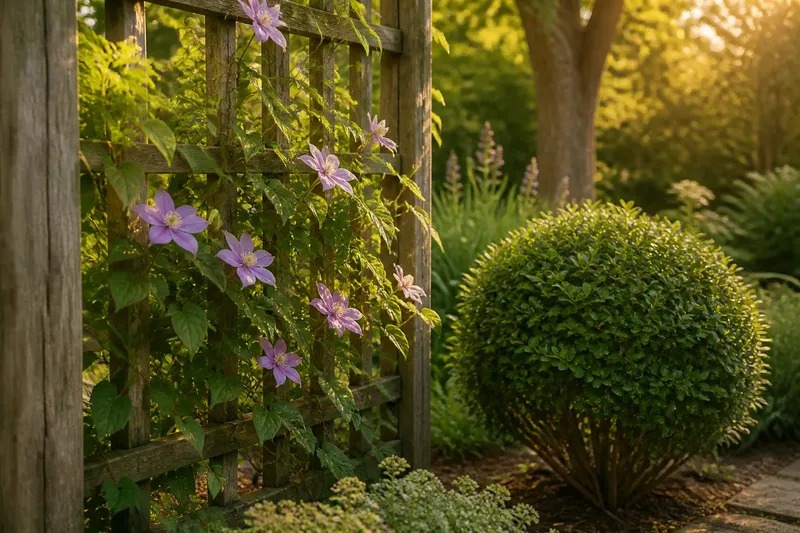
The Tidy Border Myth: Why Repetition Can Feel More Settled Than Variety
Border planting with repetition links varied plants into a readable rhythm. Choose recurring forms, place them with purpose, and keep the bed from feeling rigid.

You set a tray of perennials beside a long border, and every open patch seems to ask for a different plant. Before filling the gaps, pick a shape the bed can return to. Border planting with repetition can link varied plants without turning the edge into a rigid row.
The useful repeat is not necessarily the same species planted at equal intervals. It might be a rounded mound, an upright spire, or a certain foliage color that appears in separate groups. The eye recognizes the recurring cue; the neighboring plants give each appearance a different setting.
Choose one recognizable feature to repeat
Start with the quality you want to recur, not a shopping list. Silhouette is often easiest to read from across the garden: upright, mounded, arching, or spreading. Foliage texture and color can provide a quieter link, especially when flowers are not present.
Keep the repeat simple enough to recognize. If you ask one plant to supply the shape, another to supply the color, and a third to supply the texture, the pattern may become hard to follow. Choose one main cue, then let other features vary around it.
For a border with a strong curve, a few returning groups can echo the bend. Along a straight edge, stagger the groups rather than placing them at mechanically even intervals.
Give each repeat a role in the border
Think of the planting as a sequence of distinct moments. A repeated upright form might connect two parts of the bed, while a low mound can give the eye a pause between taller groups. Repeats can be different sizes, but each should still share a visible trait with the others.
Before buying plants, check the label or reliable local advice for mature spread, light, and moisture needs. A shape that suits the design still has to suit the spot. Mark shade, dry soil, or a tree’s roots on a quick sketch so the pattern does not depend on plants placed in conditions they cannot handle.
Say you have an invented border beside a patio: it is a curved bed with one existing upright perennial near the gate, an empty sunny middle, and a low shrub near the house. First, note that the upright shape is already visible from the patio and that the middle has similar sun. Next, plan a loose group of upright plants in that middle, using a plant whose label indicates a compatible site, and keep the low shrub as a separate pause. Then set the pots on the soil and view them from the patio. If the new group reads as a link between the gate and house, keep the layout; if the shrub hides it, shift the group toward the open curve. The expected result is a connected sequence without making every part of the bed match.
Place groups so the planting reads as a sequence
Use a rough sketch or pots on the soil; exact scaled drawings are not necessary. Mark the border’s curve, fixed features, and places where taller plants could block a view. Arrange repeated groups where they can be distinguished from one another, rather than letting them merge into one continuous mass.
Check each proposed group against these decisions:
- Observe whether the repeated form is visible from the patio or main path; if it is clear, keep its position, and if it is hidden, move it into an open sightline.
- Observe whether the group suits the sun and soil at that spot; if its growing needs match local guidance, retain the placement, and if they do not, choose a suitable plant or another location.
- Observe whether neighboring plants conceal the repeat; if the outline remains legible, leave the neighbors in place, and if it disappears, shift the group or reduce the obstruction.
- Observe whether the groups sit like evenly spaced markers; if the border still follows its curve, keep the spacing, and if it looks like a row, offset one group.
- Observe whether a repeated group crowds an existing tree, gate, or shrub; if the feature remains accessible and visible, keep the arrangement, and if it does not, open a gap around it.
- Observe whether the repeat depends on flowers alone; if foliage or stems keep the cue visible after bloom, retain the combination, and if not, add a compatible plant with a lasting form.
Change one group at a time and look again from the same place. That makes it easier to see which move improved the sequence.
Use contrast to keep recurring forms distinct
A repeated shape needs enough difference around it to remain readable. Place a fine-textured plant beside a broad mound, or let a spreading form sit near an upright one. The contrast gives each group an outline without requiring a new focal point everywhere.
Color can repeat too, but exact matching is not required. A flower color might appear in a larger group at one end and as a smaller accent elsewhere. If several bold colors compete, keep the recurring cue in foliage or form and let the flowers be more restrained.
Leave some quieter space between strong groups. A break in the pattern can make the next repeat easier to notice.
Check the border from more than one angle
View the pots from the patio, a path, and the garden entrance if those are places you actually use. A group that seems well placed head-on may disappear behind a taller plant when viewed from the side. Move the pot or group only after checking the angle where the problem appears.
Also consider what remains when blooms fade. Repeated leaf shapes, seed heads, or sturdy stems can carry a visual link beyond flowering, provided those plants suit the site. If the pattern vanishes between bloom periods, decide whether that seasonal change is welcome or whether foliage should carry more of the repeat.
How does border planting with repetition stay natural?
Do repeated groups need the same number of plants?
No. The groups can differ in size if they share a clear feature and fit their locations. Check that each still reads as a deliberate return rather than an isolated stray.
Can different plant species repeat the same form?
Yes, if their shapes are recognizable as related and their growing needs suit their locations. Compare mature silhouettes and foliage, not just the appearance of small nursery pots.
How can repetition work in a narrow border?
Use a modest recurring cue, such as upright form or a foliage tone, rather than adding many competing groups. Leave room for plants to reach their expected spread, and let the repeat appear at intervals along the bed.
What should I do with a border that is already crowded?
Look for an existing form that appears more than once and treat it as the visual link. If there is no open space for another group, avoid forcing one in; consider whether a suitable plant can be moved or whether the existing pattern is enough.
Let the planting develop before filling every gap
After planting, leave room for the plants to grow toward their mature forms. Mulch can make exposed soil look intentional while the border fills, but do not use a new plant to cover every bare patch automatically. An open interval may be what keeps the repeated groups distinct.
Border planting with repetition is most useful when it gives variety a thread to follow. Once the plants settle, keep the clear groups, make space where growth obscures them, and allow a deliberate pause where a distinctive specimen deserves attention.