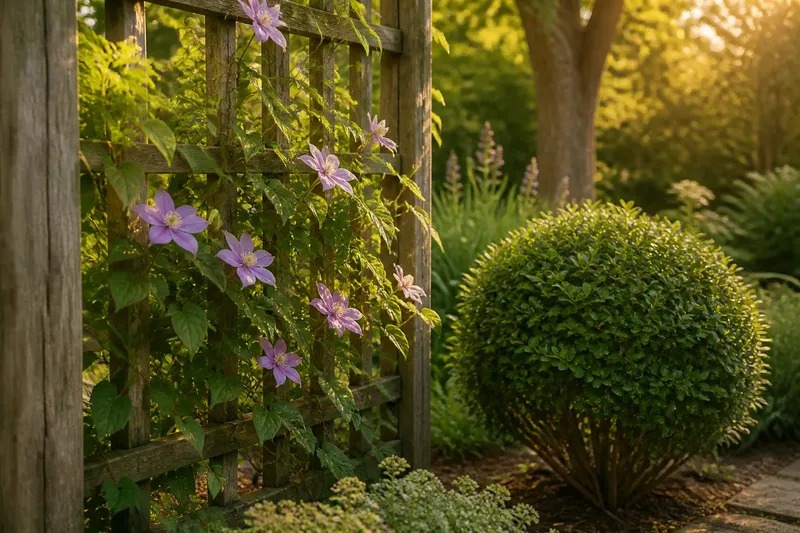
A Winter Garden Walk for Shape and Silhouette
A winter garden walk for shape and silhouette helps you read bare stems and branches, distinguish useful forms from visual clutter, and choose a sensible next move.

At the kitchen window, a bare shrub can look like a dark knot against the fence. Step onto the patio and the knot may open into a fork, a curved trunk, and a gap of sky. A winter garden walk for shape and silhouette is a way to read those outlines as they appear from the places you actually use, then decide what deserves attention.
Keep this walk separate from pruning. Bring a notebook or phone, and choose a few familiar places: the back door, a path bend, a bench, or the kitchen window. Record what each view lets you see, rather than treating every bare stem as a problem to fix.
Read the garden from your everyday routes
Start with one spot where you pause naturally, such as the patio door. Look at the outline of the garden against the fence, wall, hedge, or sky. Notice whether you can distinguish individual shapes: a branching shrub, a mound of evergreen foliage, a loose tuft of grass, or a cluster of seed heads.
Then move along a route you already take, such as the path to the shed. Watch how the scene changes as you pass a gate or turn a corner. A form that disappears from the patio may become clear from the path because the background changes or the branches no longer overlap.
Write a short note that names the place and the visible condition: “from the back door, dark branches merge with the hedge” is more useful than “the border looks messy.” The note gives you a specific view to check again.
Separate plant shape from background
A silhouette is the edge you can distinguish between a plant and what lies behind it. Fine twigs may vanish against a hedge with similarly fine texture. Pale seed heads may blend into a light wall, while dark branches can be difficult to pick out against evergreen foliage.
Move a few steps to see whether the outline becomes clearer against open sky, a fence panel, or another background. If the plant reads clearly from one position but not another, the trouble may belong to that particular view rather than to the plant. Record both the plant and its backdrop before considering a change.
For instance, “the upper branches disappear against the hedge” points to a contrast problem. “The lower stems cross the gate opening” identifies an obstruction. Those are different observations and call for different questions.
Notice which outlines hold their form
Some winter shapes remain easy to read: a distinct arch, a branching trunk, a rounded evergreen, or an upright clump of stems. Others soften as stems lean, seed heads loosen, or neighboring plants grow into one another. Look at the whole outline before focusing on a single twig.
Ask whether a plant still reads as one recognizable shape. If its stems have spread across a neighboring mound, note exactly where the edges overlap. If the clump remains distinct but looks loose, that may be a seasonal quality you prefer to keep.
Seed heads and dried stems can also provide wildlife cover or food. Consider those functions, the plant’s care needs, and the garden’s appearance before clearing them. A winter view alone does not identify which stems should be cut.
Tell a strong focal shape from a blocked view
A dark evergreen, tall shrub, or bare tree may become the boldest form after flowers and leaves recede. That does not automatically make it a design flaw. Describe what gives it weight: a dense outline, a high crown, strong contrast, or a position that fills the center of the view.
Next, check whether the form simply anchors the scene or hides something you want to see. Look for smaller outlines nearby, such as a branching shrub or a low mound. If the large shape blocks the path opening or erases a smaller plant from the main view, note that specific effect rather than writing “too big.”
Do not make a major cut on the basis of appearance alone. Identify the plant and check its care requirements; if the appropriate treatment is unclear, ask a qualified arborist or horticultural professional.
Use winter outlines to read depth and movement
A winter garden can look like a single flat band when several plants end at similar heights or their edges merge. Look for a front edge, a middle area, and a farther outline against a wall or sky. These do not need to form neat layers; the point is to see whether one shape stands apart from another.
Notice where your eye travels. Does it follow a row of upright stems toward a shrub, or stop at a dense block? A clear gap between two plants can make both outlines easier to read. Conversely, several crossing branches may flatten the view even when each plant is attractive by itself.
Imagine that, from a kitchen window, a low evergreen mound sits in front of a fence while a tall shrub’s branches blend into the fence line. You note the location, then step onto the patio and find that the shrub’s fork is clear against the sky. Your resulting decision is to treat the window view as the specific issue, not to assume the shrub needs pruning; you can later consider whether the view or surrounding growth should change.
What should I look for on a winter garden walk?
Which viewpoints should I choose?
Pick places where you regularly stop or look out, such as a doorway, bench, or path turn. Observe them separately, since each position can reveal a different outline or background.
How can I tell if a plant’s silhouette is unclear?
Check whether you can trace its edge against the background and distinguish it from nearby plants. If the form becomes clear after you shift position, record the view that obscures it rather than assuming the plant itself is the problem.
Should I cut back stems that look untidy?
Not from appearance alone. Note what is leaning or overlapping, then identify the plant and consider its care needs and any wildlife value before deciding whether to remove or support stems.
What should I do if I cannot identify a plant?
Keep the note focused on what you can see, such as “bare branches cross the gate opening,” and postpone pruning. Ask a qualified horticultural professional for plant-specific advice if you are unsure about suitable care.
Turn each note into a clear next decision
After the walk, sort observations by what is visible: a form lost against a background, branches crossing a view, stems that have collapsed, or shapes that seem to merge. Use each finding to choose one next action:
- Observation: a plant’s outline becomes clear from the path but disappears from the patio. If the contrast changes with position, then keep the plant in place for now and assess the patio view separately; otherwise, inspect what is crossing or covering the outline.
- Observation: two plants’ branches overlap at their edges. If both shapes remain distinguishable, then leave them for another seasonal look; otherwise, identify the plants before considering any adjustment.
- Observation: dried stems lean across a low plant. If the lower plant’s outline is obscured from the views you use, then check whether the stems can be supported or selectively cleared at an appropriate time; otherwise, leave them and retain their seasonal or wildlife value.
- Observation: one dense shrub dominates the view. If it blocks a feature you want to see, then identify the shrub and seek suitable care advice; otherwise, treat its strong outline as a possible focal point.
- Observation: several plants appear to form one flat band. If a small shift in viewing position separates their edges, then record that clearer viewpoint; otherwise, note which forms overlap before planning a garden change.
- Observation: dark branches vanish against a dark hedge. If the outline becomes legible against a lighter background, then record the contrast issue rather than labeling the plant shapeless; otherwise, check whether nearby branches are physically crossing it.
Keep the notes and compare the same views as the garden changes through the seasons. A winter garden walk for shape and silhouette is most useful when it helps you distinguish a view that needs attention from a quiet, bare-season outline you are happy to keep.